 Add to Chrome
 Add to Firefox
 Add to Edge
Waveform Index Modulation for Backscatter Communications in RIS-Based MIMO Radars
May 03, 2026
This paper studies a symbiotic system in which a reconfigurable intelligent surface (RIS) assists a radar transmitter while conveying information to a reader via backscattering. The RIS is partitioned into subarrays that redirect the radar signal toward the angular sector under inspection and superimpose a slow-time modulation using orthogonal phase codes, thereby implementing MIMO radar functionalities. Communication is achieved by encoding information in the selection of an unordered subset of orthogonal codewords, without altering the RIS transmit beampattern. At the reader, the proposed index modulation scheme enables low-complexity detection without requiring channel state information. Numerical results demonstrate the effectiveness of the proposed backscatter communication approach.

MealRec: Multi-granularity Sequential Modeling via Hierarchical Diffusion Models for Micro-Video Recommendation
Mar 02, 2026Micro-video recommendation aims to capture user preferences from the collaborative and context information of the interacted micro-videos, thereby predicting the appropriate videos. This target is often hindered by the inherent noise within multimodal content and unreliable implicit feedback, which weakens the correspondence between behaviors and underlying interests. While conventional works have predominantly approached such scenario through behavior-augmented modeling and content-centric multimodal analysis, these paradigms can inadvertently give rise to two non-trivial challenges: preference-irrelative video representation extraction and inherent modality conflicts. To address these issues, we propose a Multi-granularity sequential modeling method via hierarchical diffusion models for micro-video Recommendation (MealRec), which simultaneously considers temporal correlations during preference modeling from intra- and inter-video perspectives. Specifically, we first propose Temporal-guided Content Diffusion (TCD) to refine video representations under intra-video temporal guidance and personalized collaborative signals to emphasize salient content while suppressing redundancy. To achieve the semantically coherent preference modeling, we further design the Noise-unconditional Preference Denoising (NPD) to recovers informative user preferences from corrupted states under the blind denoising. Extensive experiments and analyses on four micro-video datasets from two platforms demonstrate the effectiveness, universality, and robustness of our MealRec, further uncovering the effective mechanism of our proposed TCD and NPD. The source code and corresponding dataset will be available upon acceptance.
The Quantization Trap: Breaking Linear Scaling Laws in Multi-Hop Reasoning
Feb 14, 2026Neural scaling laws provide a predictable recipe for AI advancement: reducing numerical precision should linearly improve computational efficiency and energy profile (E proportional to bits). In this paper, we demonstrate that this scaling law breaks in the context of multi-hop reasoning. We reveal a 'quantization trap' where reducing precision from 16-bit to 8/4-bit paradoxically increases more net energy consumption while degrading reasoning accuracy. We provide a rigorous theoretical decomposition that attributes this failure to hardware casting overhead, the hidden latency cost of dequantization kernels, which becomes a dominant bottleneck in sequential reasoning chains, as well as to a sequential energy amortization failure. As a result, scaling law breaking is unavoidable in practice. Our findings suggest that the industry's "smaller-is-better" heuristic is mathematically counterproductive for complex reasoning tasks.
ZK-HybridFL: Zero-Knowledge Proof-Enhanced Hybrid Ledger for Federated Learning
Jan 29, 2026Federated learning (FL) enables collaborative model training while preserving data privacy, yet both centralized and decentralized approaches face challenges in scalability, security, and update validation. We propose ZK-HybridFL, a secure decentralized FL framework that integrates a directed acyclic graph (DAG) ledger with dedicated sidechains and zero-knowledge proofs (ZKPs) for privacy-preserving model validation. The framework uses event-driven smart contracts and an oracle-assisted sidechain to verify local model updates without exposing sensitive data. A built-in challenge mechanism efficiently detects adversarial behavior. In experiments on image classification and language modeling tasks, ZK-HybridFL achieves faster convergence, higher accuracy, lower perplexity, and reduced latency compared to Blade-FL and ChainFL. It remains robust against substantial fractions of adversarial and idle nodes, supports sub-second on-chain verification with efficient gas usage, and prevents invalid updates and orphanage-style attacks. This makes ZK-HybridFL a scalable and secure solution for decentralized FL across diverse environments.
LiViBench: An Omnimodal Benchmark for Interactive Livestream Video Understanding
Jan 21, 2026The development of multimodal large language models (MLLMs) has advanced general video understanding. However, existing video evaluation benchmarks primarily focus on non-interactive videos, such as movies and recordings. To fill this gap, this paper proposes the first omnimodal benchmark for interactive livestream videos, LiViBench. It features a diverse set of 24 tasks, highlighting the perceptual, reasoning, and livestream-specific challenges. To efficiently construct the dataset, we design a standardized semi-automatic annotation workflow that incorporates the human-in-the-loop at multiple stages. The workflow leverages multiple MLLMs to form a multi-agent system for comprehensive video description and uses a seed-question-driven method to construct high-quality annotations. All interactive videos in the benchmark include audio, speech, and real-time comments modalities. To enhance models' understanding of interactive videos, we design tailored two-stage instruction-tuning and propose a Video-to-Comment Retrieval (VCR) module to improve the model's ability to utilize real-time comments. Based on these advancements, we develop LiVi-LLM-7B, an MLLM with enhanced knowledge of interactive livestreams. Experiments show that our model outperforms larger open-source models with up to 72B parameters, narrows the gap with leading proprietary models on LiViBench, and achieves enhanced performance on general video benchmarks, including VideoMME, LongVideoBench, MLVU, and VideoEval-Pro.
The Llama 4 Herd: Architecture, Training, Evaluation, and Deployment Notes
Jan 15, 2026This document consolidates publicly reported technical details about Metas Llama 4 model family. It summarizes (i) released variants (Scout and Maverick) and the broader herd context including the previewed Behemoth teacher model, (ii) architectural characteristics beyond a high-level MoE description covering routed/shared-expert structure, early-fusion multimodality, and long-context design elements reported for Scout (iRoPE and length generalization strategies), (iii) training disclosures spanning pre-training, mid-training for long-context extension, and post-training methodology (lightweight SFT, online RL, and lightweight DPO) as described in release materials, (iv) developer-reported benchmark results for both base and instruction-tuned checkpoints, and (v) practical deployment constraints observed across major serving environments, including provider-specific context limits and quantization packaging. The manuscript also summarizes licensing obligations relevant to redistribution and derivative naming, and reviews publicly described safeguards and evaluation practices. The goal is to provide a compact technical reference for researchers and practitioners who need precise, source-backed facts about Llama 4.
SiamMM: A Mixture Model Perspective on Deep Unsupervised Learning
Nov 07, 2025Recent studies have demonstrated the effectiveness of clustering-based approaches for self-supervised and unsupervised learning. However, the application of clustering is often heuristic, and the optimal methodology remains unclear. In this work, we establish connections between these unsupervised clustering methods and classical mixture models from statistics. Through this framework, we demonstrate significant enhancements to these clustering methods, leading to the development of a novel model named SiamMM. Our method attains state-of-the-art performance across various self-supervised learning benchmarks. Inspection of the learned clusters reveals a strong resemblance to unseen ground truth labels, uncovering potential instances of mislabeling.
Texture-aware Intrinsic Image Decomposition with Model- and Learning-based Priors
Sep 11, 2025This paper aims to recover the intrinsic reflectance layer and shading layer given a single image. Though this intrinsic image decomposition problem has been studied for decades, it remains a significant challenge in cases of complex scenes, i.e. spatially-varying lighting effect and rich textures. In this paper, we propose a novel method for handling severe lighting and rich textures in intrinsic image decomposition, which enables to produce high-quality intrinsic images for real-world images. Specifically, we observe that previous learning-based methods tend to produce texture-less and over-smoothing intrinsic images, which can be used to infer the lighting and texture information given a RGB image. In this way, we design a texture-guided regularization term and formulate the decomposition problem into an optimization framework, to separate the material textures and lighting effect. We demonstrate that combining the novel texture-aware prior can produce superior results to existing approaches.
Plug-and-play Diffusion Models for Image Compressive Sensing with Data Consistency Projection
Sep 11, 2025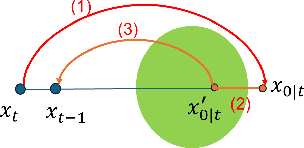
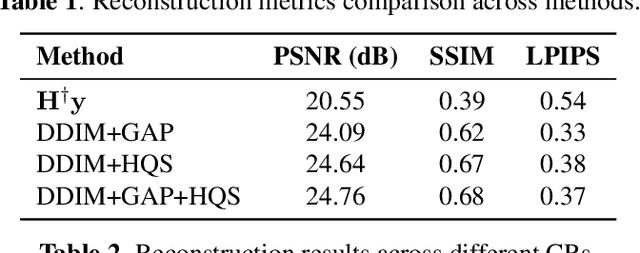
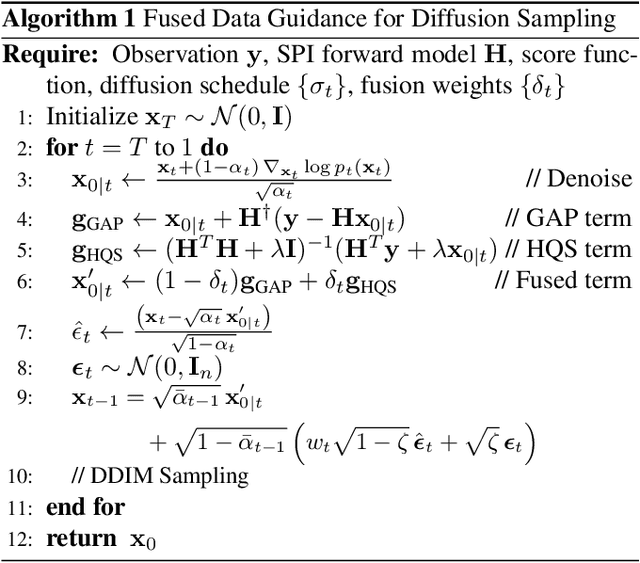
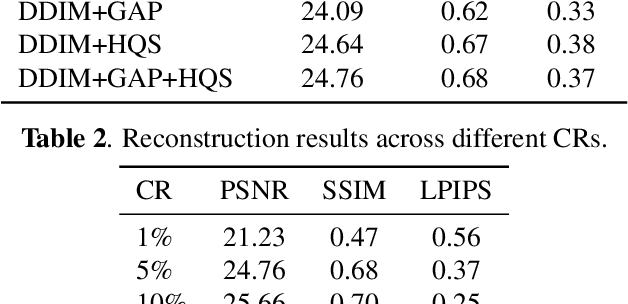
We explore the connection between Plug-and-Play (PnP) methods and Denoising Diffusion Implicit Models (DDIM) for solving ill-posed inverse problems, with a focus on single-pixel imaging. We begin by identifying key distinctions between PnP and diffusion models-particularly in their denoising mechanisms and sampling procedures. By decoupling the diffusion process into three interpretable stages: denoising, data consistency enforcement, and sampling, we provide a unified framework that integrates learned priors with physical forward models in a principled manner. Building upon this insight, we propose a hybrid data-consistency module that linearly combines multiple PnP-style fidelity terms. This hybrid correction is applied directly to the denoised estimate, improving measurement consistency without disrupting the diffusion sampling trajectory. Experimental results on single-pixel imaging tasks demonstrate that our method achieves better reconstruction quality.
Unfolding Framework with Complex-Valued Deformable Attention for High-Quality Computer-Generated Hologram Generation
Aug 29, 2025Computer-generated holography (CGH) has gained wide attention with deep learning-based algorithms. However, due to its nonlinear and ill-posed nature, challenges remain in achieving accurate and stable reconstruction. Specifically, ($i$) the widely used end-to-end networks treat the reconstruction model as a black box, ignoring underlying physical relationships, which reduces interpretability and flexibility. ($ii$) CNN-based CGH algorithms have limited receptive fields, hindering their ability to capture long-range dependencies and global context. ($iii$) Angular spectrum method (ASM)-based models are constrained to finite near-fields.In this paper, we propose a Deep Unfolding Network (DUN) that decomposes gradient descent into two modules: an adaptive bandwidth-preserving model (ABPM) and a phase-domain complex-valued denoiser (PCD), providing more flexibility. ABPM allows for wider working distances compared to ASM-based methods. At the same time, PCD leverages its complex-valued deformable self-attention module to capture global features and enhance performance, achieving a PSNR over 35 dB. Experiments on simulated and real data show state-of-the-art results.